Bedtime Yoga in Bed: A 10-Minute Practice You Never Have to Leave the Mattress For
For the nights you’re already under the covers and the last thing you want is to get up.
 Melania Romanelli15 August 2026 · 8 min read
Six slow shapes, done lying down, in the ten minutes before you sleep. The point isn’t to stretch — it’s to give your nervous system enough slow, boring input that it stops treating bedtime as something to stay alert for. You can do the whole thing without sitting up.
Most bedtime yoga sequences assume you have a mat, a clear patch of floor, and twenty minutes of willingness. On the nights that matters most — the ones where you are wrung out and your mind has just started replaying the day — you have none of those things. You have a bed, and you are already in it.
So this practice never asks you to get up. Six shapes, roughly ten minutes, all done lying down or sitting on the mattress. I teach it in exactly this form because it is the version people actually do.
Why gentle movement helps you fall asleep
Falling asleep is not a decision. It is a handover — from the branch of your nervous system that keeps you alert and responsive, to the one that runs digestion, repair and rest. Most nights that handover happens on its own. On the difficult nights, your body is still braced from the day and won’t make the switch just because the light is off.
Slow movement and long, unhurried exhales are one of the few things that reliably nudge that handover along. Nothing mystical: when the exhale is longer than the inhale and the body is still, the signals travelling up to the brain change character. You are giving your system evidence that nothing needs handling right now.
This is also why pushing harder backfires. A deep stretch that makes you brace is more stimulation, not less. Everything below should feel almost too easy.
Before you start
- Two pillows within reach — one for your head, one to prop under a knee or hip.
- Lights low. If your phone is the light source, it is also the problem.
- Loose covers. If you are fighting a tucked sheet, you will brace against it.
The practice
- Settle and lengthen the exhale · 90 seconds Lie on your back, knees bent, feet on the mattress. One hand on your belly. Breathe in for a count of four, out for a count of six. Do not force the length — let the exhale trail off rather than pushing it. Six or seven rounds is enough.
- Knees to chest, slow rock · 60 seconds Draw both knees toward your chest and hold behind the thighs. Rock a few centimetres side to side, no more. This is a massage for the lower back, not a stretch. Keep the breath going underneath it.
- Supine twist, both sides · 2 minutes Knees together, drop them to the right, turn your head left if the neck allows. Put a pillow under the knees so they are supported rather than hanging. Stay eight slow breaths. Come back through the middle and repeat on the other side. Do not chase the floor — the point is the release, not the depth.
- Reclined butterfly · 2 minutes Soles of the feet together, knees falling open, a pillow under each knee if there is any pull in the groin. Hands wherever they land. This one opens the front of the hips, where a whole day of sitting collects. Stay until it stops feeling like a stretch and starts feeling like nothing much.
- Legs up the headboard · 2 minutes Shuffle close to the headboard or the wall and rest your legs up against it, or simply stack both calves on a pile of pillows. Either works. This is the shape people report the most from — heaviness draining out of the legs, the day going with it.
- Side-lying finish · until you drift Roll onto your right side, knees bent, a pillow between the knees and another under the head so the neck stays neutral. Return to the long exhale from step one. Do not set an end point. This is where the practice stops being something you do and starts being sleep.
Follow the practice on video
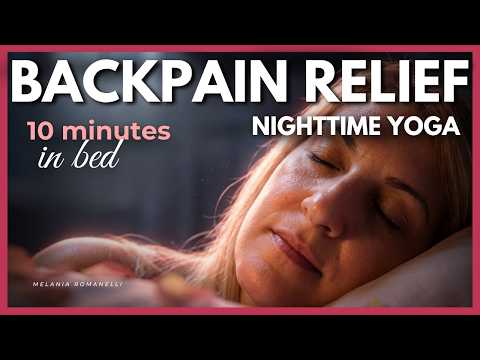
If you would rather be told what to do than remember an order, follow the video and let your eyes close whenever they want to. There is also a shorter eight-minute version for beginners if ten minutes feels like a lot tonight.
What to expect, honestly
The first few nights, your mind will probably keep talking through the whole thing. That is not failure and it does not mean the practice isn’t working — the calming effect comes from the breathing and the stillness, and those happen whether or not your thoughts cooperate.
What tends to shift first is not how fast you fall asleep, but how you feel while waiting. The waiting stops being adversarial. Speed usually follows a week or two later, once your body starts recognising the sequence as the thing that comes before sleep.
And on the nights it does nothing at all — because those exist — you have still spent ten minutes lying down breathing slowly, which is a better use of a difficult night than scrolling.
Where to go next
If lying still appeals more than moving, yoga nidra is the version where you do nothing but listen. And if you want the practices arriving on their own rather than remembering to look them up, the free 7-Day Sleep Reset below sends one a night for a week.
Questions people ask
Can I really do yoga in bed, or is a mattress too soft?
A mattress is soft, and that is fine here. These shapes are passive — you are not bearing weight or balancing, so the softness works in your favour. If a pose feels unstable, add a pillow underneath rather than pressing harder into the bed.
How long before sleep should I practise?
Right before, or in the twenty minutes beforehand once screens are down. Unlike stronger evening yoga, this practice is designed to be the last thing you do, so there is no need to leave a gap before lying down.
What if I fall asleep in the middle of it?
Then it worked. There is no benefit to finishing the sequence. Falling asleep partway through is the intended outcome, not a failed practice.
Do I need to be flexible?
No. Every shape here is held passively and can be made smaller with a pillow. Depth is irrelevant — the calming effect comes from slow breathing and stillness, not from range of motion.
Is this the same as yoga nidra?
No. Bedtime yoga involves gentle movement; yoga nidra is entirely still and guided by a voice. They pair well: move for ten minutes, then lie back and listen. There is a separate piece on how yoga nidra works.
Seven nights, one short practice each
The 7-Day Sleep Reset is a free email series: one gentle practice a night, each under twelve minutes, all done in bed.
Get the 7-Day Sleep Reset — freeThis article is for general education and is not medical advice. If sleep problems persist, please speak with a doctor. See the full disclaimer.